
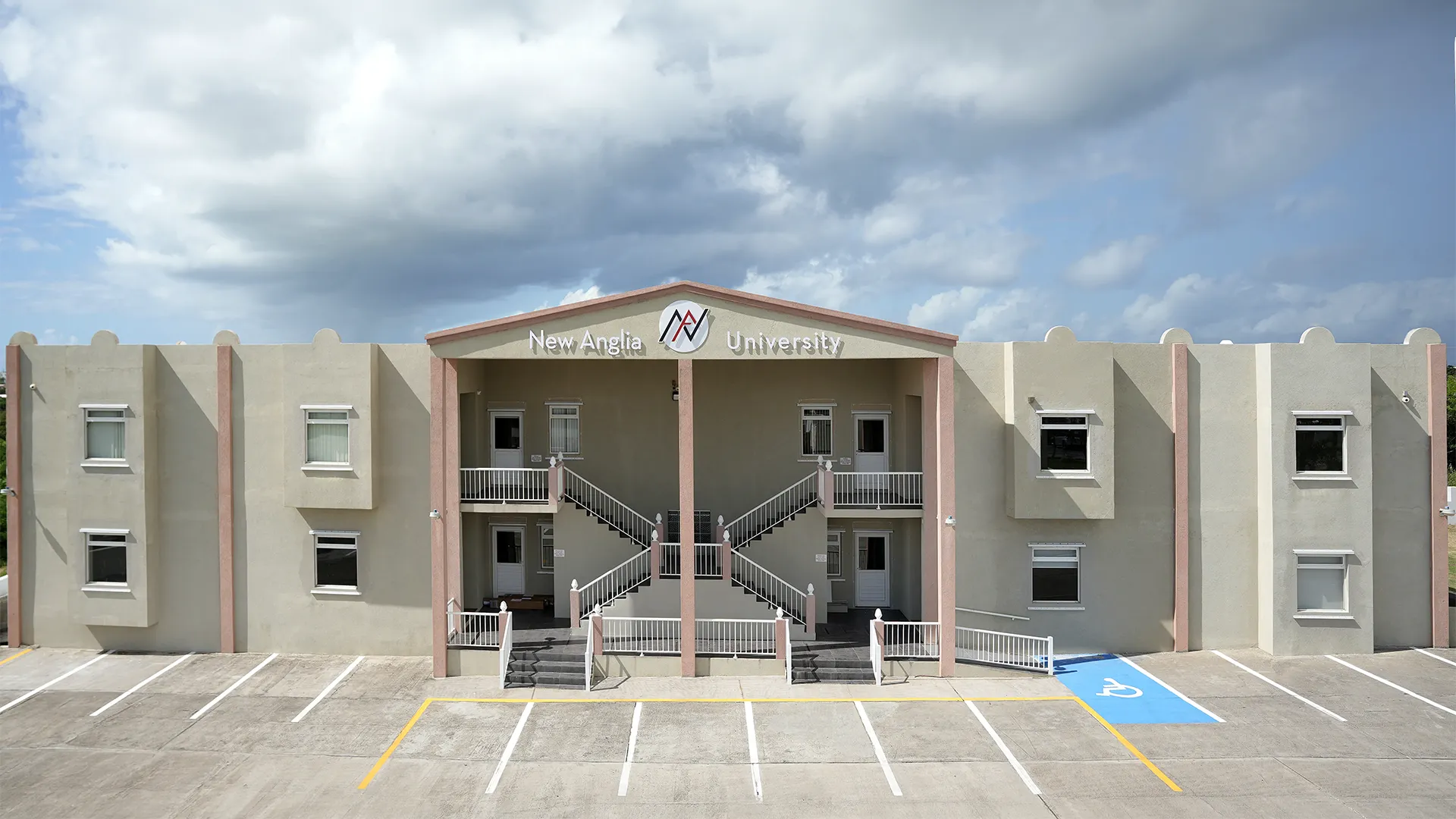
Why Study Medicine at New Anglia University?
Admission
No entry exams
Tuition fees
$3600/term
Undergraduate Entry
5 Years
Intake
January, May, September
Graduate Entry
4 Years
UK, U.S. CLINICAL ROTATIONS (2 YEARS) – UK/US
Included in tuition fees
+
 Why Choose New Anglia University in the Caribbean?
Why Choose New Anglia University in the Caribbean?
- New Anglia University (NAU) is a prestigious medical school founded on principles of world-class education in the heart of Anguilla in the Caribbean Islands.
- The NAU curriculum is structured to support students academically and personally with progressive modules from Basic Sciences to Clinical Sciences.
- NAU offers modern medical education from an experienced, diverse faculty creating an inclusive learning environment.
- The university is a positive, supportive learning community training students for global medical practice.
+
 The 5-Year Undergraduate Programme
The 5-Year Undergraduate Programme
- Graduates of the NAU 5-Year Undergraduate Premedical and MD Programme are qualified with a Doctor of Medicine (MD) degree.
- Undergraduate medicine is taught in English over five years, with a structure of: one year of Premedical modules for 51 weeks, Basic Sciences for 85 weeks, and Clinical Sciences for 72 weeks.
- Premedical Program:
- Students study the 90-credit foundation programme to build their knowledge of foundational academic modules. The premedical curriculum consists of three 15-week terms, of modules with intensive coursework across natural sciences, mathematics, and social sciences.
- MD Programme:
- After the successful completion of the premedical course, students study the 4-year MD program.
- Basic Sciences comprises five terms of modules, requiring students to be on campus for a total of 20 months.
- The last two years of Clinical Sciences consists of 72 weeks of rotations in hospital settings under direct supervision.
+
The 4-Year Graduate Medicine Programme
The 4-Year Graduate Medicine Programme
- Graduates from NAU’s 4-Year Graduate Medicine Programme have a Doctor of Medicine (MD) degree qualification.
- Students complete four years of studies: the first two years comprise 85 weeks of Basic Sciences, and the final two years comprise 72 weeks of Clinical Sciences.
- The Basic Sciences curriculum spans five terms, requiring students to attend on-campus modules for 20 months.
- Over the final two years, the programme is structured into Clinical Sciences consisting of clinical rotations.
- Clinical rotations are structured into: 48 weeks (Internal Medicine: 12 weeks, Surgery: 12 weeks, Pediatrics: 6 weeks, Family Medicine: 6 weeks, Psychiatry: 6 weeks, Obstetrics and Gynaecology: 6 weeks); then, Elective Rotations for 24 weeks.
- Graduate programme students can complete their clinical rotations in NHS Hospitals and GP Surgeries in the UK.
+
 What do the Clinical Rotations in the UK and U.S. involve?
What do the Clinical Rotations in the UK and U.S. involve?
- NAU undergraduate and graduate programme students complete their two years of Clinical Sciences in the UK and the U.S.
- These modules are undertaken during the final two years of both programmes as core clinical rotations and elective clinical rotations.
- Clinical rotations build diverse student experience in real medical settings with ward rounds and grand rounds, morning reporting, work rounds, and self-directed learning.
- Throughout the two years of clinical rotations, students consistently complete patient consultation and care that prepares them for medical practice.
- UK and U.S. Clinical rotations are covered in NAU tuition fees, so there are no additional charges for rotations in the UK.
+
Applications for UK Students
Applications for UK Students
- British applicants interested in NAU’s Medical Degree can study a 5-year Premedical and MD programme for undergraduate students, or a 4-year MD programme tailored for graduate entry students.
- Applications are open to British nationals or residents who meet undergraduate or graduate entry criteria.
- Undergraduate applicants should have A-Levels or Level 3 qualification.
- Graduate applicants require a Bachelor’s Degree in a science-related field.
- To apply, students submit application documents with three annual intakes (January, May, and September).
+
Applications for American & Canadian Students
Applications for American & Canadian Students
- For undergraduate programmes, applicants must be high school graduates; for graduate programmes, applicants must have a science-related Bachelor’s Degree or 90 credit hours of undergraduate studies.
- These programmes are taught in English, annual intakes are in January, May, and September, and annual tuition fees are £12,000.
- NAU holds an ECFMG Sponsor Note listing in the World Directory of Medical Schools for the U.S. and Canada.
- During clinical training, both programmes comprise clinical sciences studies in U.S. hospitals beginning with Core Rotations, then progressing to Elective rotations.
- This extensive practical exposure develops clinical skills ahead of postgraduate training and specialisation.
- The NAU clinical rotations encompass specialties and settings with Ward Rounds, Grand Rounds, Morning Report, Work Rounds, Attending Rounds in Clinic, Dedicated Teaching, and Self-Directed Learning.
-
For Canadian students, the NAU degree:
- Aligns with the requirements of the Medical Council of Canada (MCC) to practice medicine in Canada
- Allows you to take the Medical Council of Canada Qualifying Examination (MCCQE) Part I and the National Assessment Collaboration (NAC)
- Offers integrated achievement tests offered by the National Board of Medical Examiners (NBME)
- Gives you eligibility to participate in the Canadian Residency Matching Service (CaRMS)
+
Applications for Australian Students
Applications for Australian Students
- Applicants who are Australian Nationals or Residents are eligible to apply for NAU’s programmes: the Pre-Medical and MD 5-Year Programme for Undergraduates and the MD 4-Year Programme for Graduates.
- For the Undergraduate Programme, applicants must hold the Australian Senior Secondary Certificate of Education (SSCE) qualification.
- For the Graduate Programme, eligibility is based on a Bachelor’s Degree, such as a BSc, or 90 credit hours of under-graduate studies.
- The programme curriculum is entirely taught in English, there are three intakes a year (January, May, September), and annual tuition fees are £12,000.
- NAU is listed in the Australian Medical Council (AMC) database of eligible medical schools and the MD qualifica-tion is recognised in Australia.
- Australian students complete all clinical rotations in Anguillian hospitals and clinics.
- The NAU Clinical Sciences curriculum is structured into two sequential phases, Core Rotations, then Elective Rota-tions, completed in U.S. Hospitals.
- This intensive clinical training develops foundational and specialist skills in a dynamic healthcare setting with pa-tients and medical professionals.
- Australian students complete rigorous clinical rotations covering Ward Rounds, Grand Rounds, Morning Report, Work Rounds, Attending Rounds, Dedicated Teaching, and Self-Directed Learning.
-
NAU’s programmes offers Australian medical students a degree that:
- Qualifies you to sit the Australian Medical Board Exam — both the AMC Computer Adaptive Test (CAT) Multiple Choice Question (MCQ) Examination and the Clinical Examination.
- Prepares you for the National Board of Medical Examiners (NBME) achievement tests for Basic Sciences and Core Clinical Clerkships
+
 How Much Does It Cost To Study Medicine In the Caribbean?
How Much Does It Cost To Study Medicine In the Caribbean?
| Programme | Programme Starts | Annual Fees (£) |
|---|---|---|
| Medicine | January, May & September |
Basic: $3600 /term (5 Terms) Clinicals: $5,500 /term (6 Terms) |
| Living Costs | Anguilla Monthly ($) | Anguilla Annually ($) |
|---|---|---|
| Rent | 300–580 | 3600–6000 |
| Food | 80–120 | 960–1440 |
| Utility Bills (Electricity, Gas & Water) | 70 | 840 |
| Internet | 40 | 480 |
| Transportation | 30 | 360 |
| Total | 520–760 | 6300–9100 |
+
Admission to New Anglia University
Admission to New Anglia University
Applicants must provide the following information:
- An application which includes the following details: bio, education history, and course for which you are applying.
- A copy of your secondary education results with subjects studied.
- Two small photos of 4-5cm.
- A personal statement.
- Two letters of recommendation.
+
 What’s Student Life in George Hill Like?
What’s Student Life in George Hill Like?
- George Hill is one of Anguilla’s 14 districts, close to beaches and tropical landscapes.
- The George Hill area is accessible and economical for students with lifestyle benefits including extensive rental accommodations and bike infrastructure.
- NAU is centrally located in George Hill so students enjoy a tight-knit community, vibrant campus life, and a supportive buddy network.
- Students can quickly feel settled in George Hill as the entire island’s official language is English and it’s straightforward to connect with local people and services.
+
 What’s It Like for International Students To Live and Study Medicine?
What’s It Like for International Students To Live and Study Medicine?
- Anguilla is a British Overseas Territory in the Lesser Antilles Volcanic Arc in the Caribbean Sea, south of the North Atlantic Ocean.
- The island territory is serviced by an international airport, inter-island ferries, and an extensive network of driver services.
- Anguillian culture is welcoming and tolerant with a mixed demographic population with diverse faiths and multiple languages spoken.
- Students living in Anguilla are connected to the UK with multiple flight routes enabling easy accessibility.
Watch Our Videos
Real Success StoriesOpen DaysEntry ExamsNetworking Events
Reviews


+ 2023
2023
2023




+2022
2022




+2021
2021





+2020
2020


+2019
2019




+2018
2018






+2017
2017
+2016
2016


+2015
2015
+2014
2014